liveCase studycryptosecurity
History of Crypto
A dated catalog of crypto incidents, from the Bitcoin whitepaper to whatever broke this month
Visit the site ↗
On this page
What it is
history.harrydenley.com is a dated catalog of things that actually happened in crypto. Not a recap blog. Not a news feed. Each record is a single event with a day, a category, a severity, and usually a source.
There are 1,600+ published events right now, from the Bitcoin whitepaper (31 October 2008) through the current month, and 600+ participants — exchanges, protocols, wallets, regulators, and people. The point is to answer a boring, useful question: has this happened before, and what did it look like when it did?
I got tired of the same exploit class being treated like a novelty every cycle. Bridges, approval phishing, compromised socials, MEV theatre — none of it is new. It just gets memory-holed.
The front page
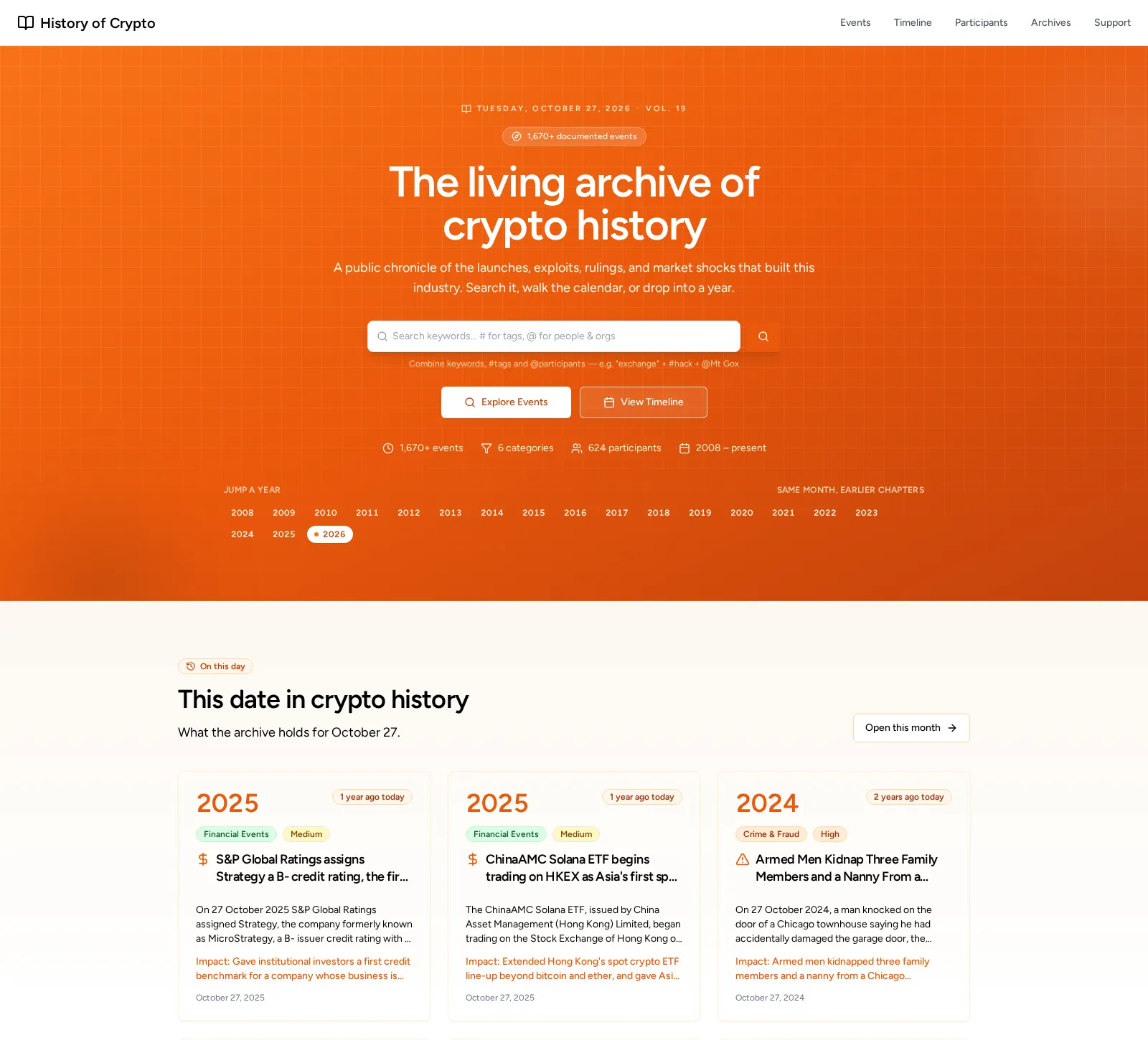
The home page opens on a search box, then This date in crypto history: what landed on today's date in previous years. Below that are featured events and the six categories, each with a link into the catalog.
Search
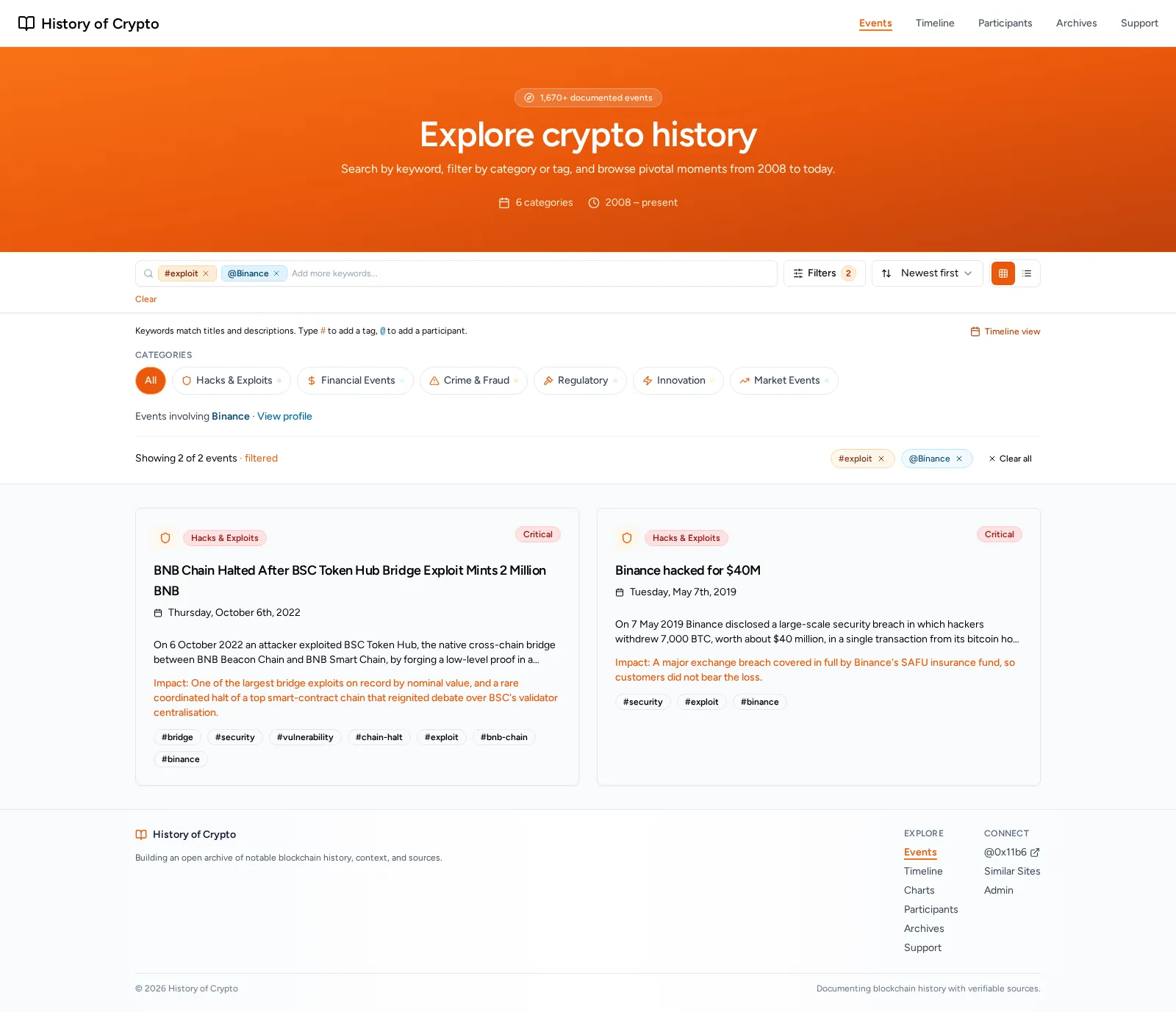
/events is the full catalog. Type words to match titles and descriptions, # to add a tag, and @ to add a participant. Filters stack, so #exploit plus @Binance gives you every Binance exploit and nothing else. You can also narrow by category, severity, and year, and sort newest or oldest first.
Every filtered view is a URL, so you can send someone Binance's exploits and they see the same list.
The timeline
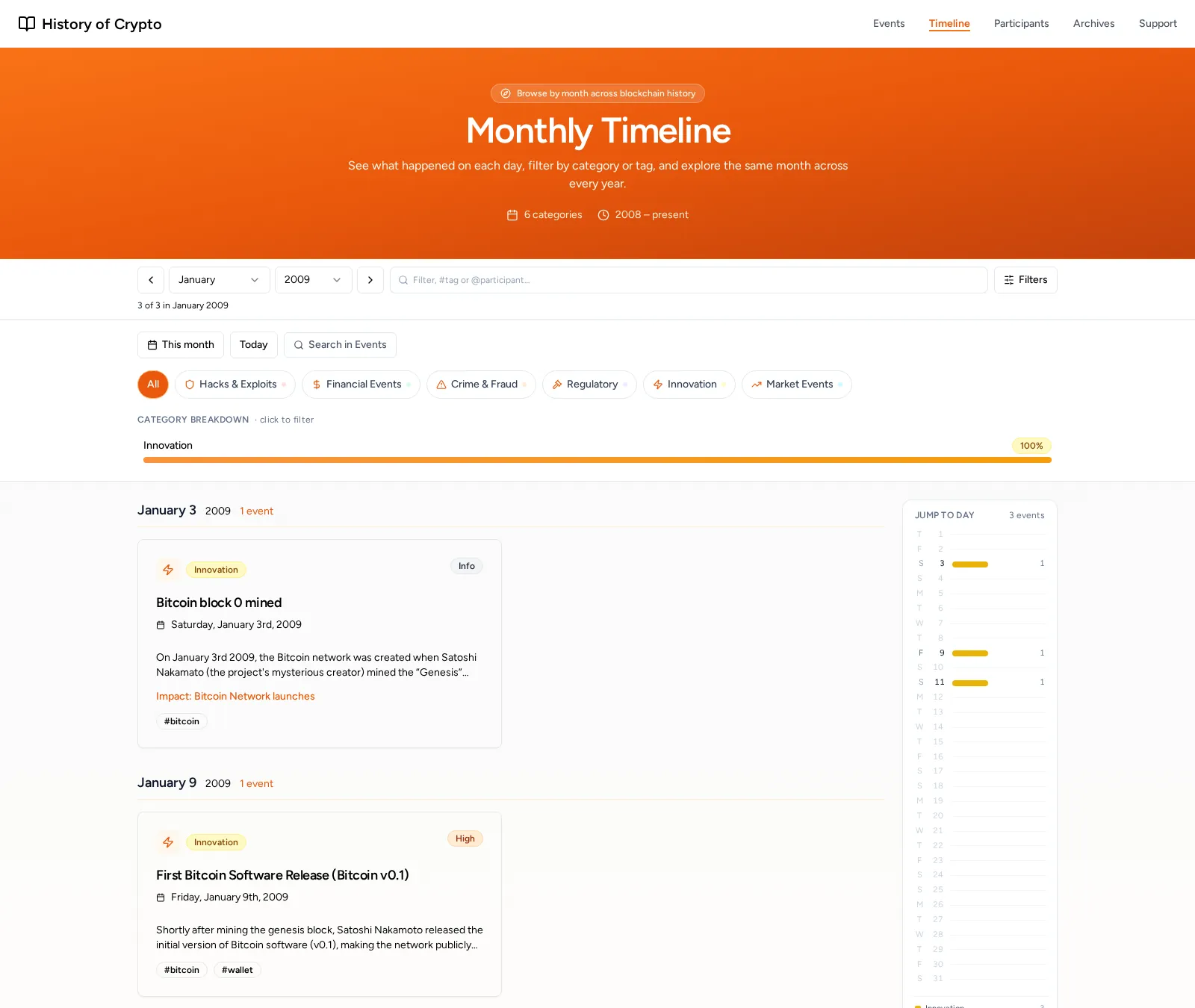
/timeline is one month at a time. Pick a month, and every event in it is listed by day, with the same category and tag filters as search. January 2009 is where it starts.
An event
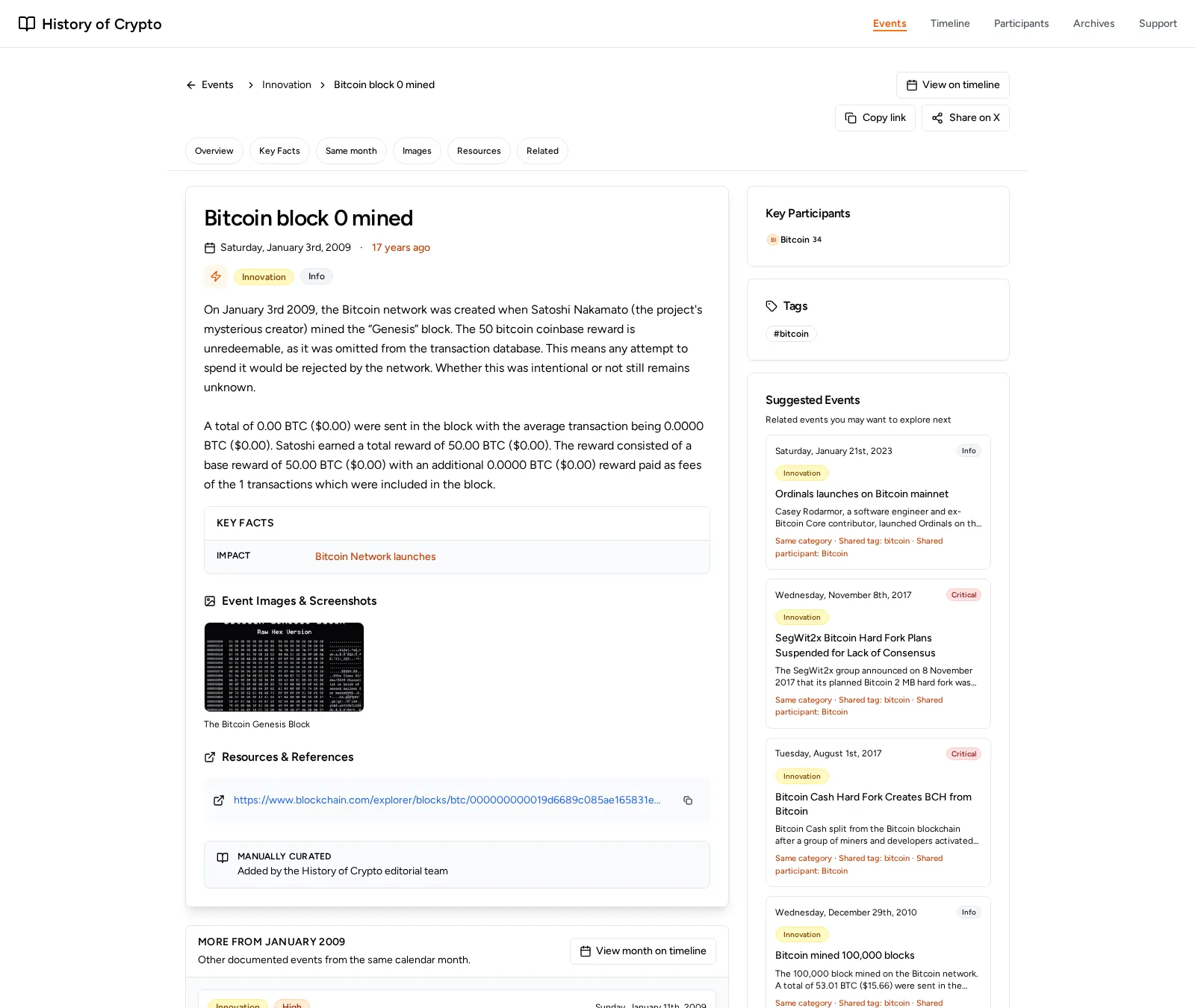
An event page is a short file, not an essay:
- title, date, and how long ago it was
- category and severity (Critical, High, Medium, Low, or Info)
- the impact in one line
- a description, and technical details when they exist (reentrancy, API keys, whatever actually broke)
- key facts, images, and outbound sources
- the participants and tags, and suggested events that share them
- other events from the same month
Example: The DAO (17 June 2016) is filed under Hacks & Exploits, marked Critical, and the technical note is the reentrancy / checks-effects-interactions lesson — not a vibe. Bitcoin block 0 is Innovation, marked Info.
Every event can be copied as a link or shared to X, and each one gets its own social card.
The six categories
Every published event sits in one of these:
- Hacks & Exploits — protocol bugs, contract vulns, stolen keys
- Financial Events — crashes, raises, institutional checks
- Crime & Fraud — scams, Ponzis, prosecutions
- Regulatory — bans, rulings, policy
- Innovation — launches, upgrades, standards
- Market Events — listings, delistings, halts
Crime & Fraud is the biggest by a distance. Tags cut across all six (ethereum, defi, wallet, arrest, mining), and each tag and each category has its own page.
Participants
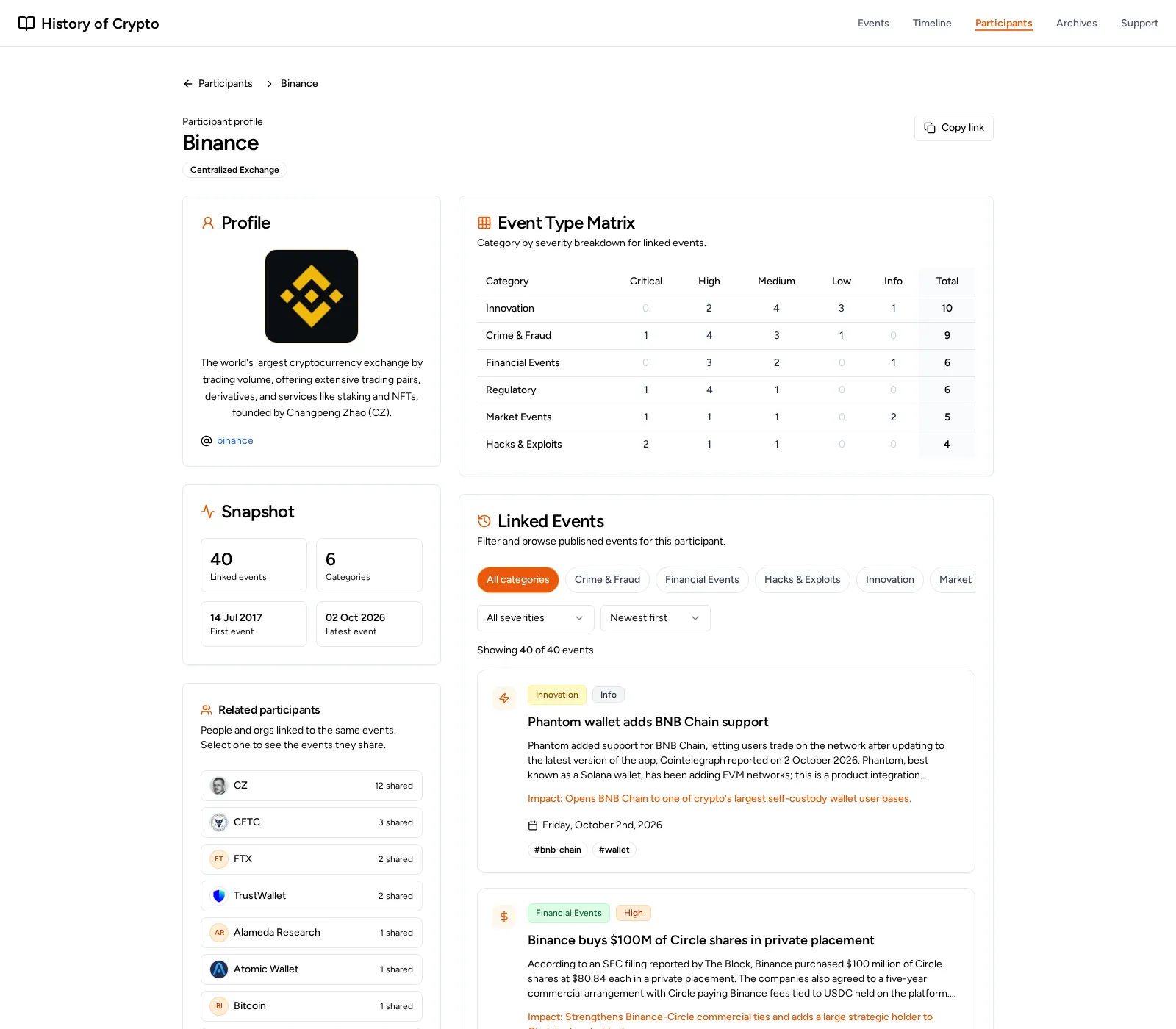
Every company, protocol, and person has a page. You get a short profile, how many events they're in and when the first and latest were, a category by severity matrix, and every linked event with filters.
Down the side are related participants: whoever shows up in the same events, and how many they share. Click one and you get the events that involve both.
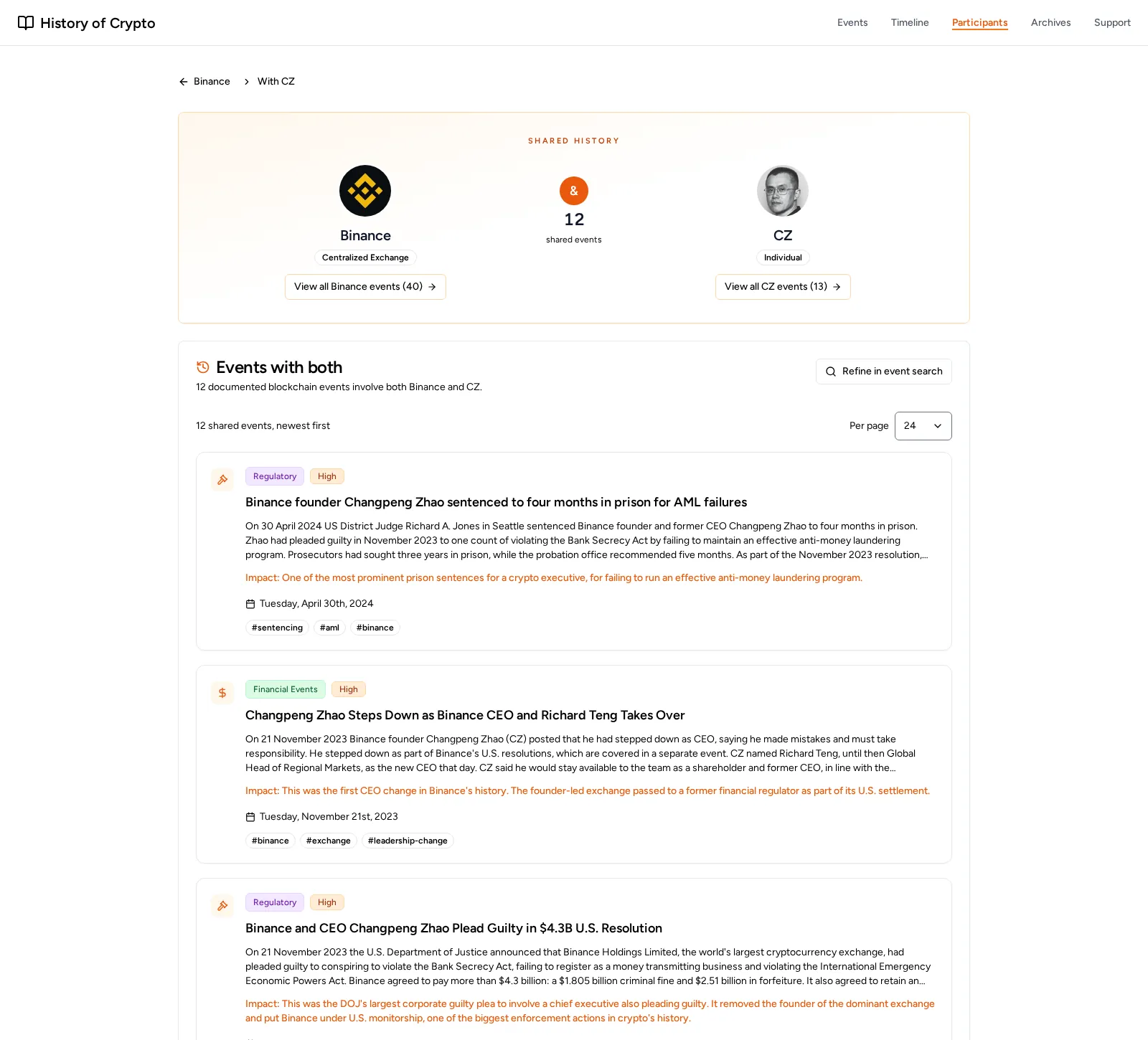
That's Binance and CZ: every event with both of them in it, newest first. It's the quickest way to follow a relationship through the catalog instead of grepping titles.
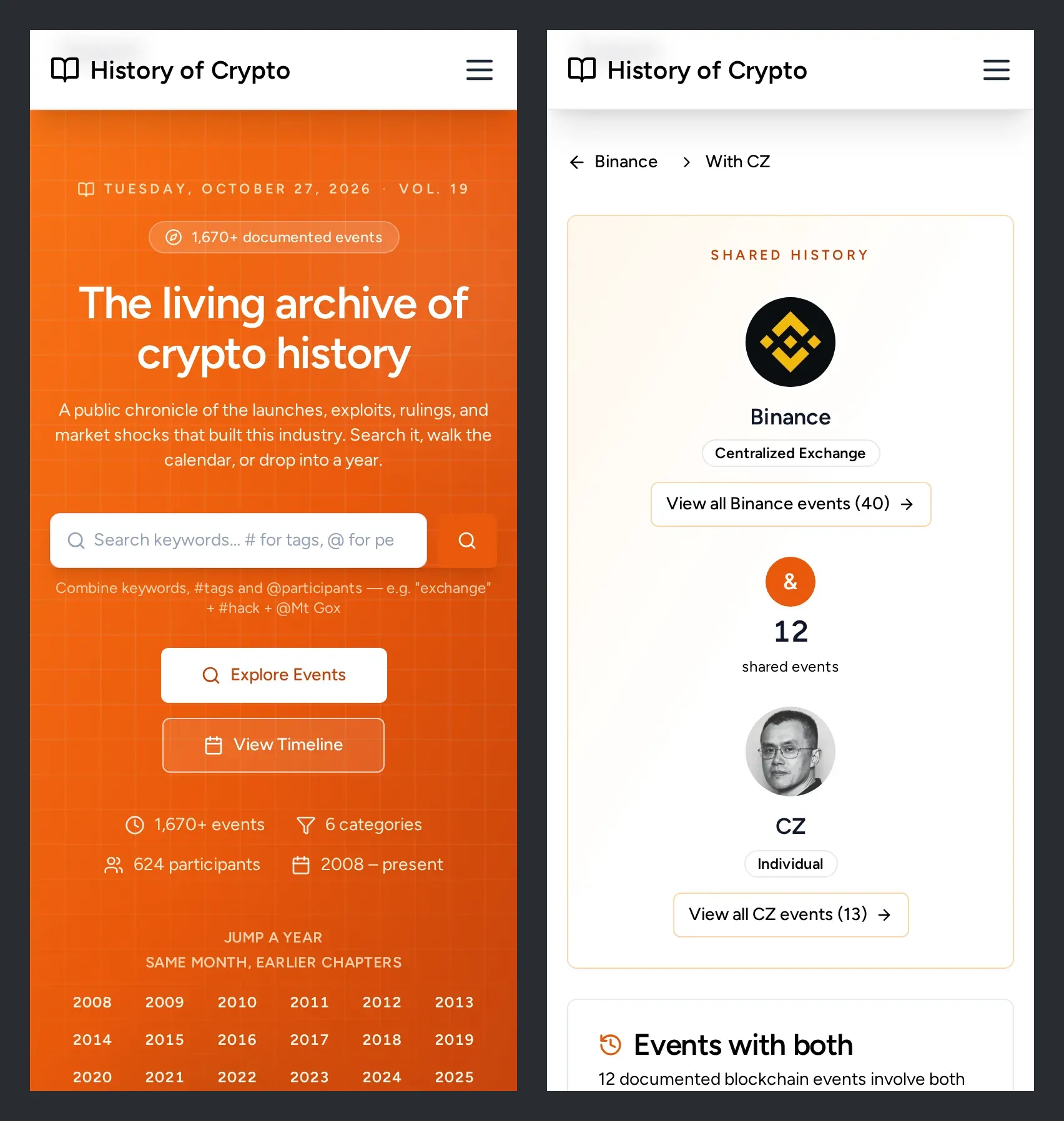
On a phone it's the same page in one column.
Charts
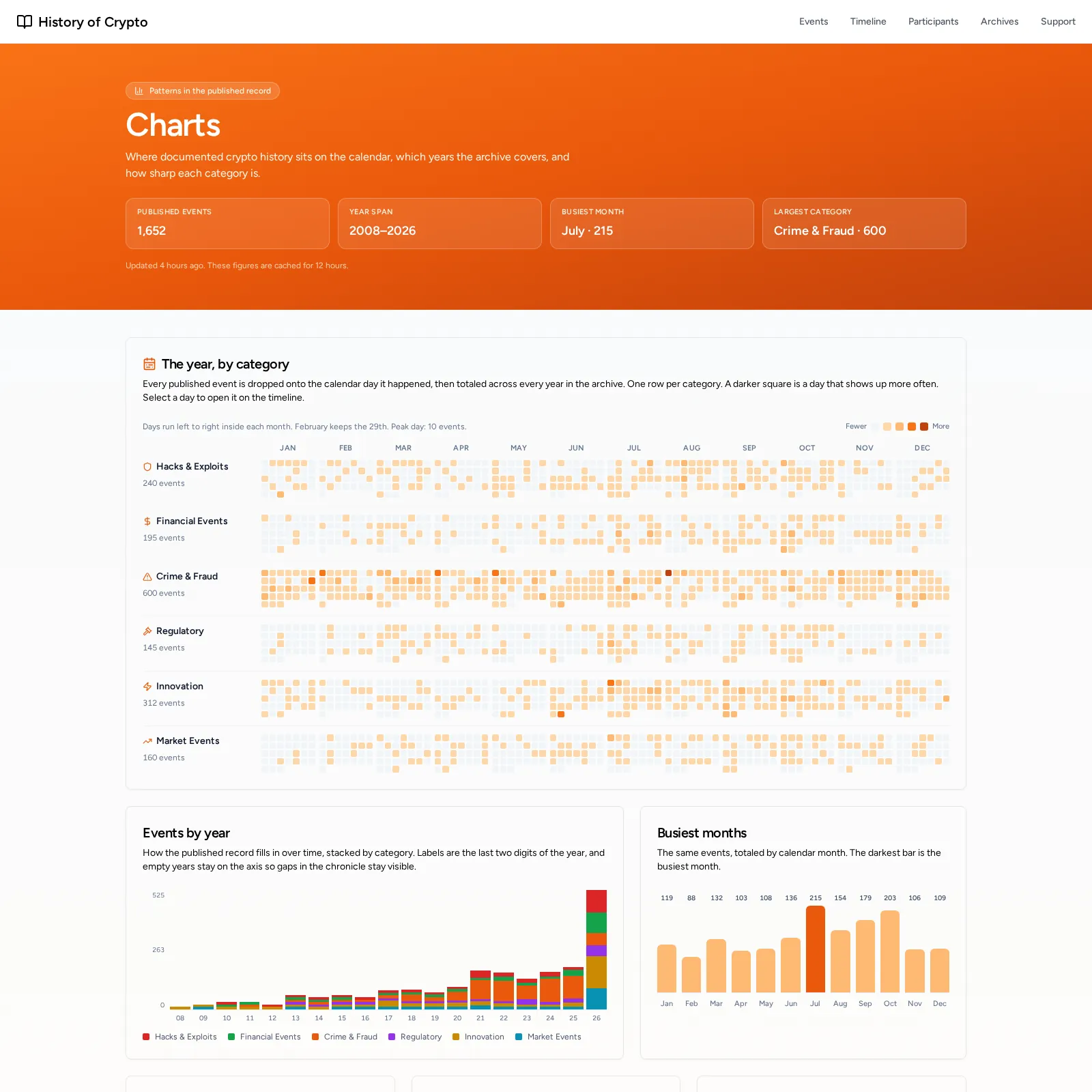
/charts is the catalog as a whole: the busiest month and category, a heatmap of category against year, events per year, the severity mix, and the most common tags and participants. Coinbase and Binance are at the top.
On This Day
If an event is flagged for anniversary, it goes out as an "On this day" post from @CryptoHistory_. One day can be a short thread, one post per event. Same record, same URL, a short prompt to remember the actual incident.
That is the distribution, not the product. The product is the dated file. The post is how people bump into it without opening the site.
Archives
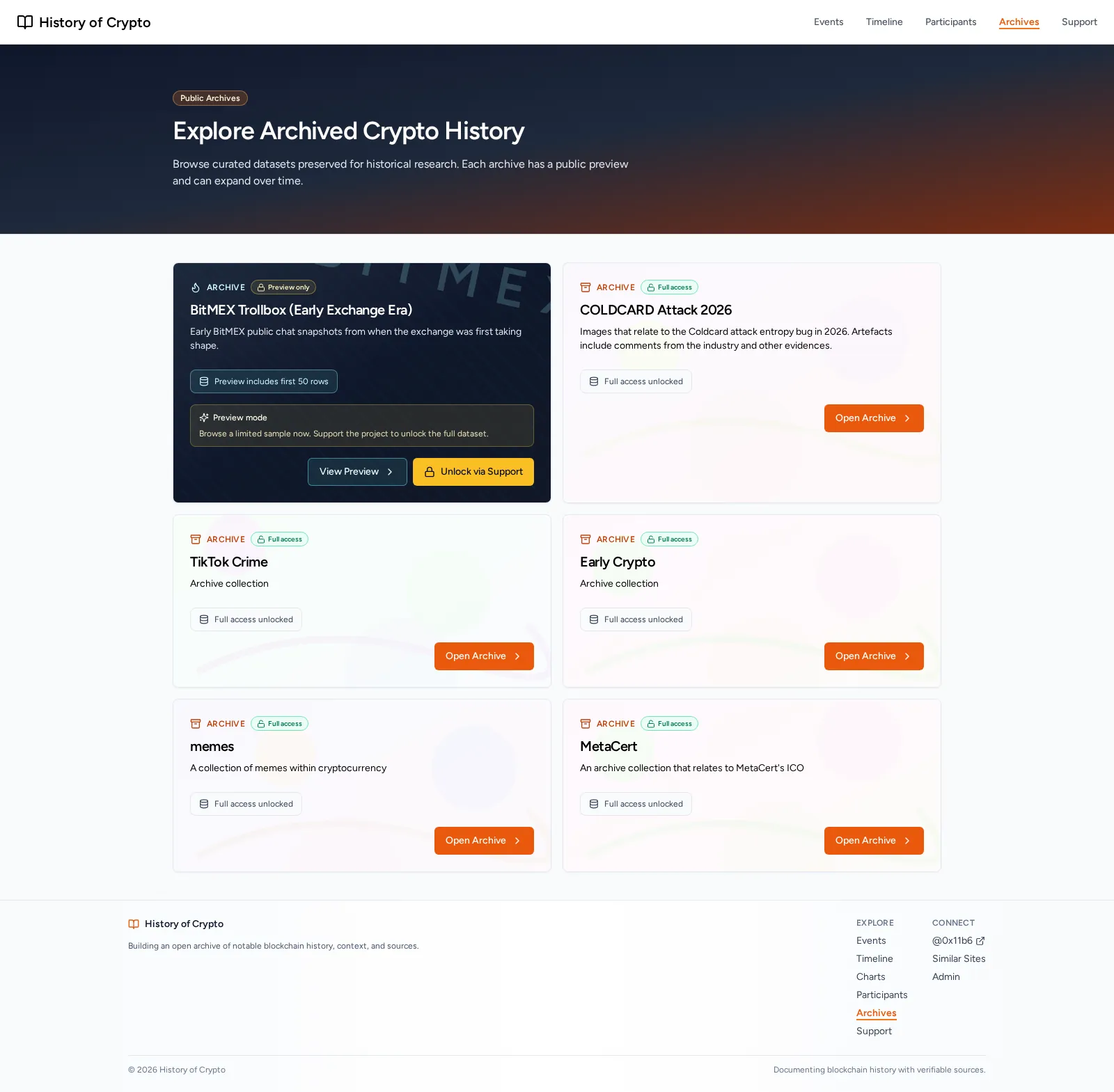
Separate from the event log, /archives holds source collections that do not fit a single day:
- BitMEX trollbox chat from the early exchange era (membership-locked)
- COLDCARD / entropy-bug artefacts from 2026
- TikTok crime
- early crypto
- memes
- MetaCert's ICO
These are dumps and evidence, not recaps. The event log can point at them; they are not a substitute for it.
API
The catalog is public JSON.
GET /api/v1/public/events— paginated listGET /api/v1/public/events/{uuid}— one eventGET /api/v1/public/events/export— the lot
There is also an authenticated agent API for ingesting structured events (categories, tags, similar-title checks) so new records do not have to be typed in by hand. Admin can draft from a URL and run them through a moderation queue before they go live.
I did not bolt on a public "submit anything" box. Garbage in, garbage forever.
How it's built
Laravel, with Inertia and React for the pages and Tailwind for the styling. Participant avatars are served as WebP. If you want to help keep it running, /support takes donations to a multisig, and a membership unlocks the BitMEX archive.
Why it exists
Crypto has almost no institutional memory. The primary sources are tweets, Discord dumps, and postmortems that rot when a startup dies. People relearn the same approval scam, the same bridge assumption, the same "our Twitter got owned" playbook.
This is a place to put the date on it, keep the source, and make it findable next year. That is the whole job.
