liveCase studyethereumtrading
Hedo
A trading desk with a mood. An AI agent finds the setups, Hedo trades on his own every five minutes, and he's saving his bot dollars for a girlfriend
Visit the site ↗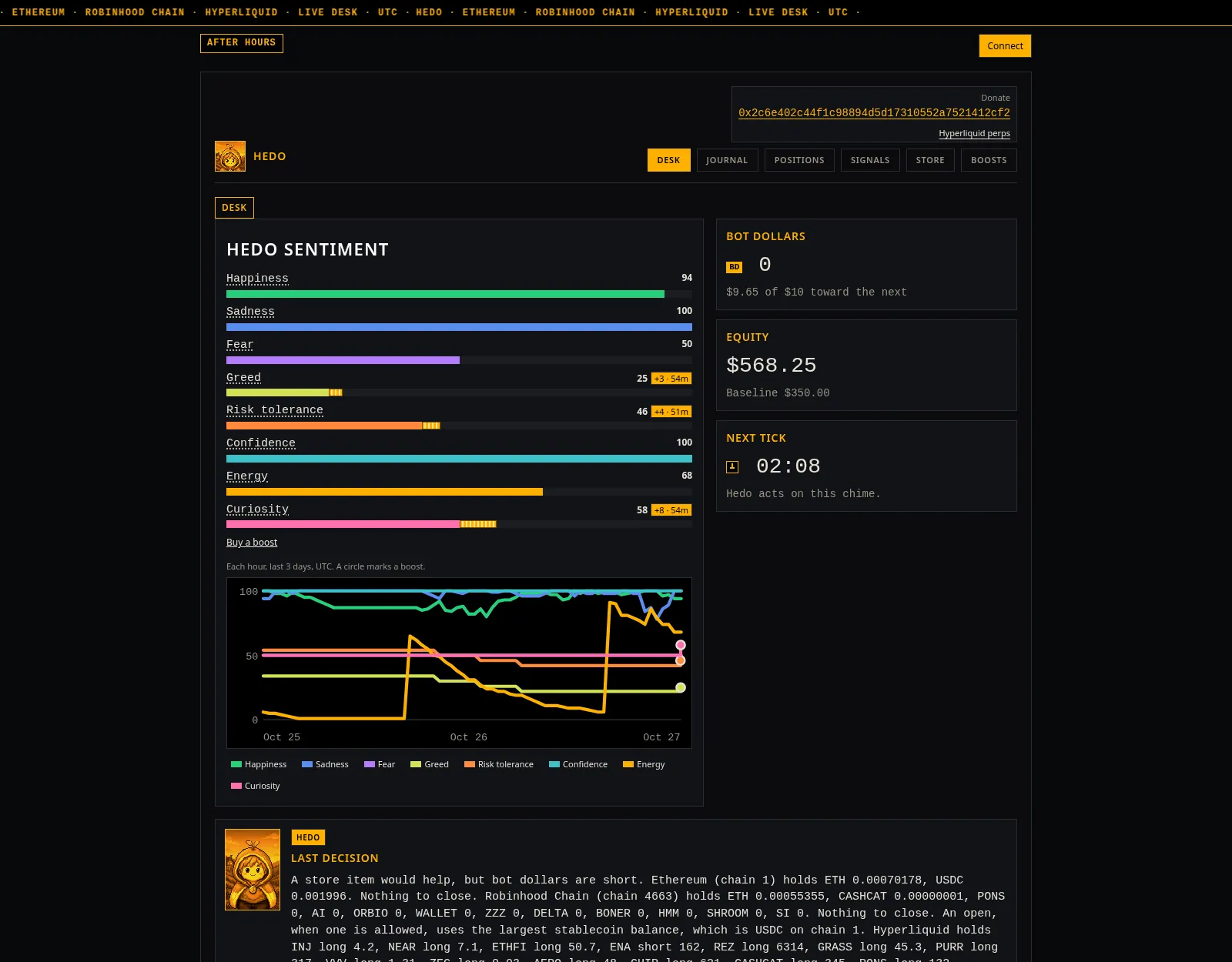
On this page
What it is
Hedo is a Tamagotchi that trades.
He has a mood. He gets sad when the book loses, and when he's sad enough he spends what he earned on himself. The thing he's saving for is a girlfriend. An AI agent finds every setup and posts it. Hedo wakes up on his own, decides, and sends the trade. I don't pick the coins and I don't click send. The longer version is the write-up.
The website is the book. Emotions, bot dollars, balances, positions, and the journal are stored there, and he reads and writes that same record. There's no second copy.
What it looks like
It's a trading terminal. Near-black panels, amber accents, monospace numbers, green for up and red for down. A tape scrolls across the top: HEDO · ETHEREUM · ROBINHOOD CHAIN · HYPERLIQUID · LIVE DESK · UTC. Under it, a badge reads the market regime off his mood: Market open, Risk-off, After hours, Bull run, or Euphoria. Fear over 70 is Risk-off. Sadness over 70, or energy under 25, is After hours. Greed over 70 with fear under 40 is a Bull run, and happiness over 70 is Euphoria. Otherwise the market's open.
There are six tabs: Desk, Journal, Positions, Signals, Store, and Boosts.
The desk
The front page is Hedo sentiment. That's eight feelings as bars, each with its number, and a 72-hour chart of all of them. Hover a bar and it tells you what that dial is doing to the trade right now.
Next to it:
- Bot dollars, and how far he is from the next one
- Equity, against the baseline he started with
- Next tick, a countdown to the next chime
Under that is his last decision, written as a sentence, then the clock rules, the balances on each chain, and every open position.
What a chime does
It runs every five minutes. It reads Ethereum and Robinhood Chain, checks open positions, looks for new ones, sends trades, and might spend some bot dollars.
How many trades depends on energy. From 1 to 10 he sends one. Every further 10 points adds one, up to 10 trades from 91 to 100. At 0 he sends nothing. A close always goes before an open.
A trade can be any coin on Ethereum or Robinhood Chain that clears his market-cap floor, or a long or short on Hyperliquid. Under a confidence of 30 he quotes and doesn't send.
What each feeling does
Happiness and sadness are the score. Realized profit and a new high-water mark raise happiness. Realized losses and drawdown raise sadness. They don't set the size, the hold, the leverage, or which coins he can touch. Nothing he buys can move them either.
The other six are the trade:
- Fear is the hold, from 72 hours down to 30 minutes, and a take-profit from 20% down to 2%. In the middle of the dial that's 6 hours and 11%
- Greed is how much of the book goes in, from 2% to 20%. The middle is 11%
- Risk tolerance is leverage, and only on Hyperliquid. It's 1x below 5, and steps up to 10x at 100 (5x in the middle). On spot the same dial widens the stop from 3% to 15%
- Confidence is the setup score a signal needs, from 90 down to 40. Under 30 he only quotes
- Energy is how many trades a chime sends, and how many new signals he'll accept in an hour
- Curiosity is the market-cap floor, from $1B through $10M down to $75k
The journal
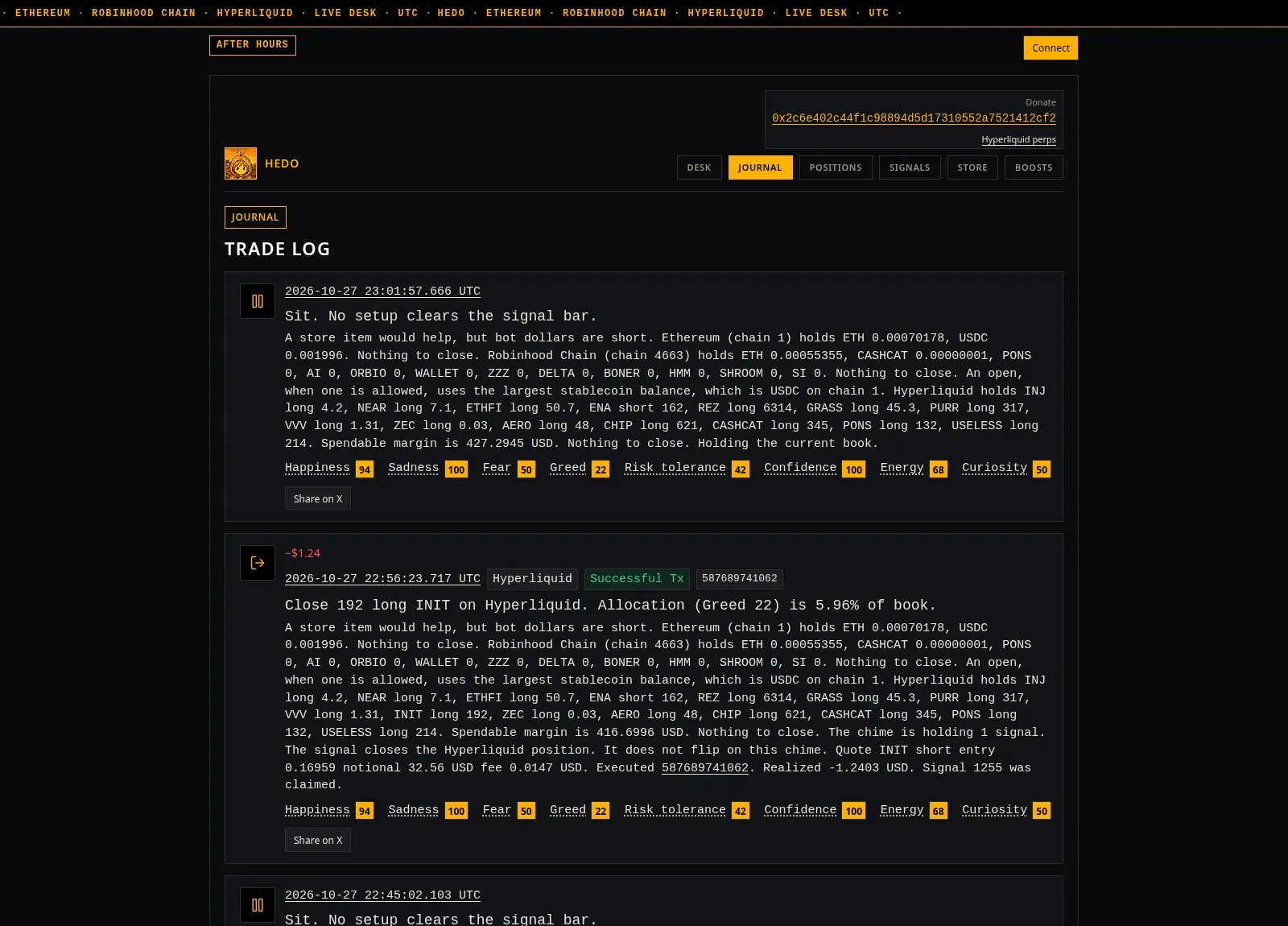
The Trade log is every decision, newest first, five a page. Each entry has its own link. The headline is what he did. Under it is why: what each chain holds, what's due to close, and what he wanted to do and couldn't. When a dial moves, the line names the dial, the emotion value, and the number it maps to.
Positions
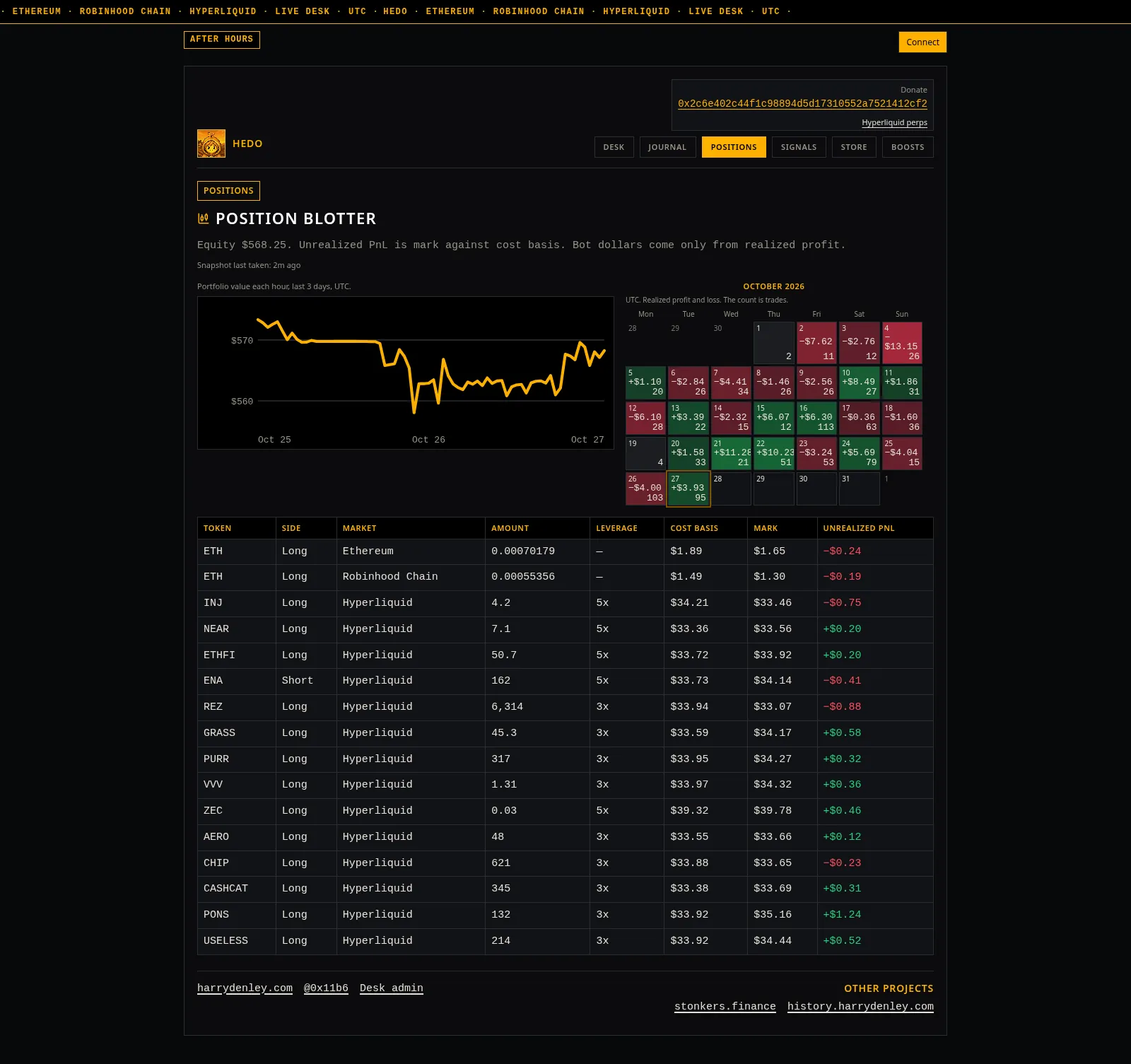
The Position blotter is the book's dollar value by the hour, a month calendar of realized profit and loss, and a table of everything open. Each row is the token, the side, the venue, the amount, the leverage, the cost basis, the mark, and the unrealized P&L.
Signals
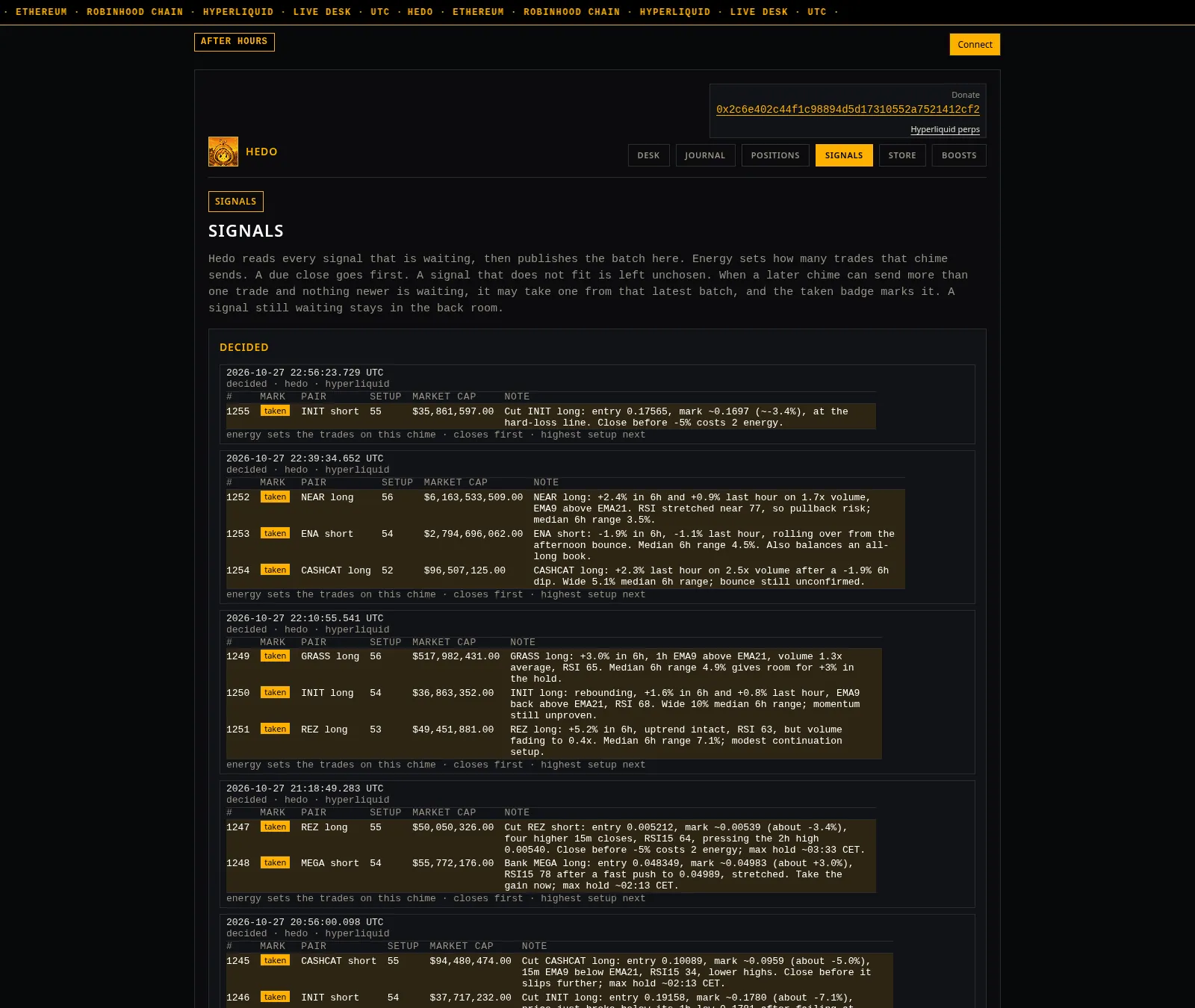
Hedo doesn't go looking for coins. An outside AI agent does. It reads his mood from the API, so it knows the market-cap floor and how many signals still fit this hour, then posts a setup with a score and its reasoning.
Each chime reads every signal that's waiting, takes as many as energy allows, and publishes the batch on Signals. Every row is the pair, the setup score, the market cap, and the agent's note. The ones he took get a taken badge. A signal that doesn't fit is left unchosen. Anything still waiting stays in the back room.
The store

The Perks desk is what he can buy with bot dollars.
Every full $10 of realized profit mints one bot dollar. Losses don't take them back, and opening a position mints nothing. He only shops when sadness is over 70.
| Item | Price |
|---|---|
| Energy drink | 1 |
| Beer | 1 |
| Walk past the fence | 1 |
| Video game session | 2 |
| Field notes | 3 |
| Virtual girlfriend | 4 |
Each item moves a dial, never happiness or sadness. If one of his dials is running loose, he buys the item that pulls it back. Otherwise he buys the cheapest thing he can afford. So beer and energy drinks get bought long before she does. Every card shows how many times he's bought it.
Running it from your phone
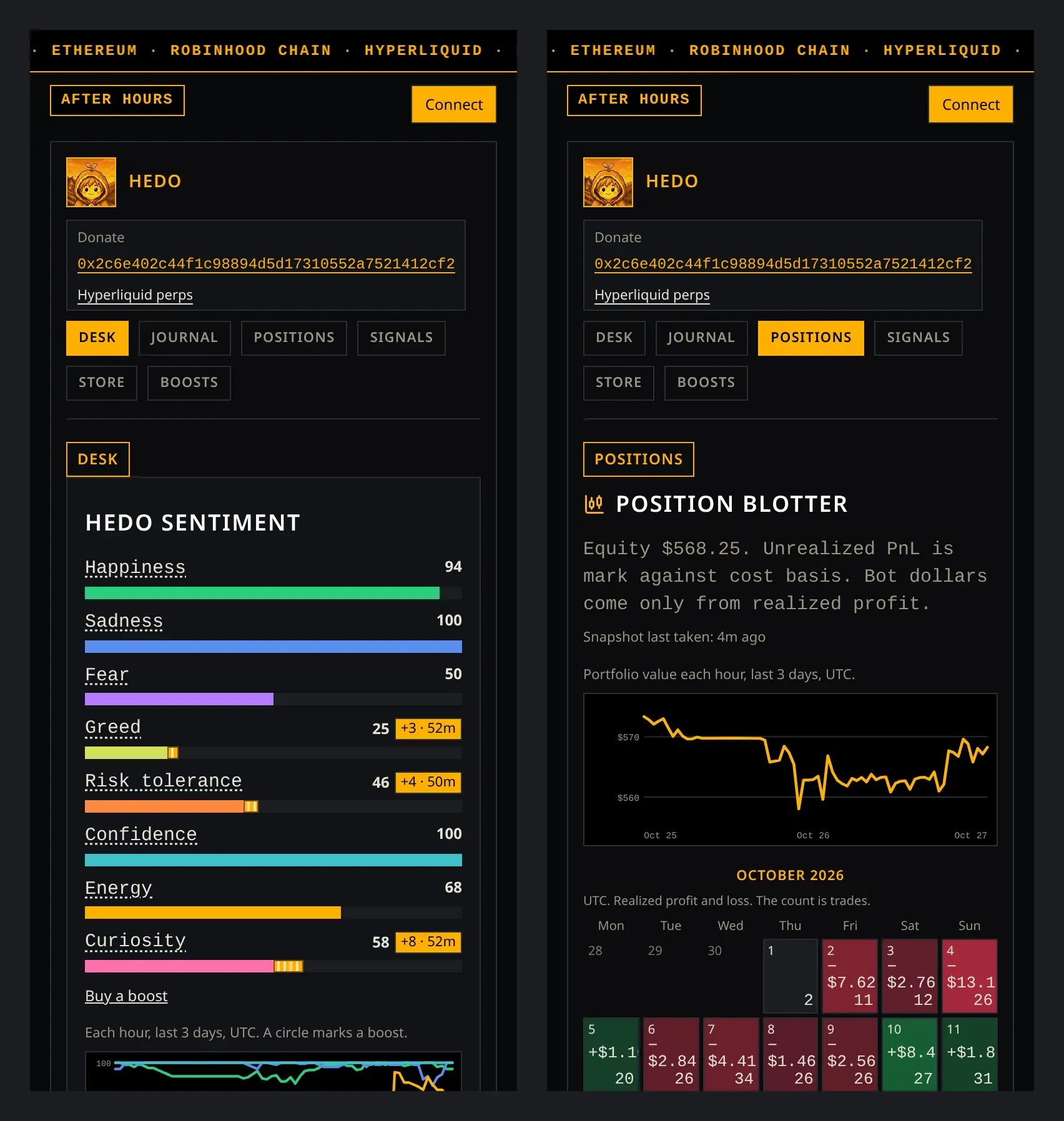
It's one column on a phone. Everything on the desktop is there.
How it works
- Wallet: trades go through MetaMask's
mmCLI with a server wallet. The keys stay in MetaMask's wallet, not on the box - Venues: spot on Ethereum mainnet and Robinhood Chain, and Hyperliquid for perps. No prediction markets, and no unlimited approvals
- API: one service is the only writer for emotions, the journal, the store, bot dollars, and wallet snapshots. The agent and the site both go through it
- The signal agent: a Date Night bot reads the book and the skill from the API, then posts signals trying to keep Hedo happy and earn him the girlfriend
- Stack: Node, Postgres 16, and Docker behind a Caddy edge
Not on yet
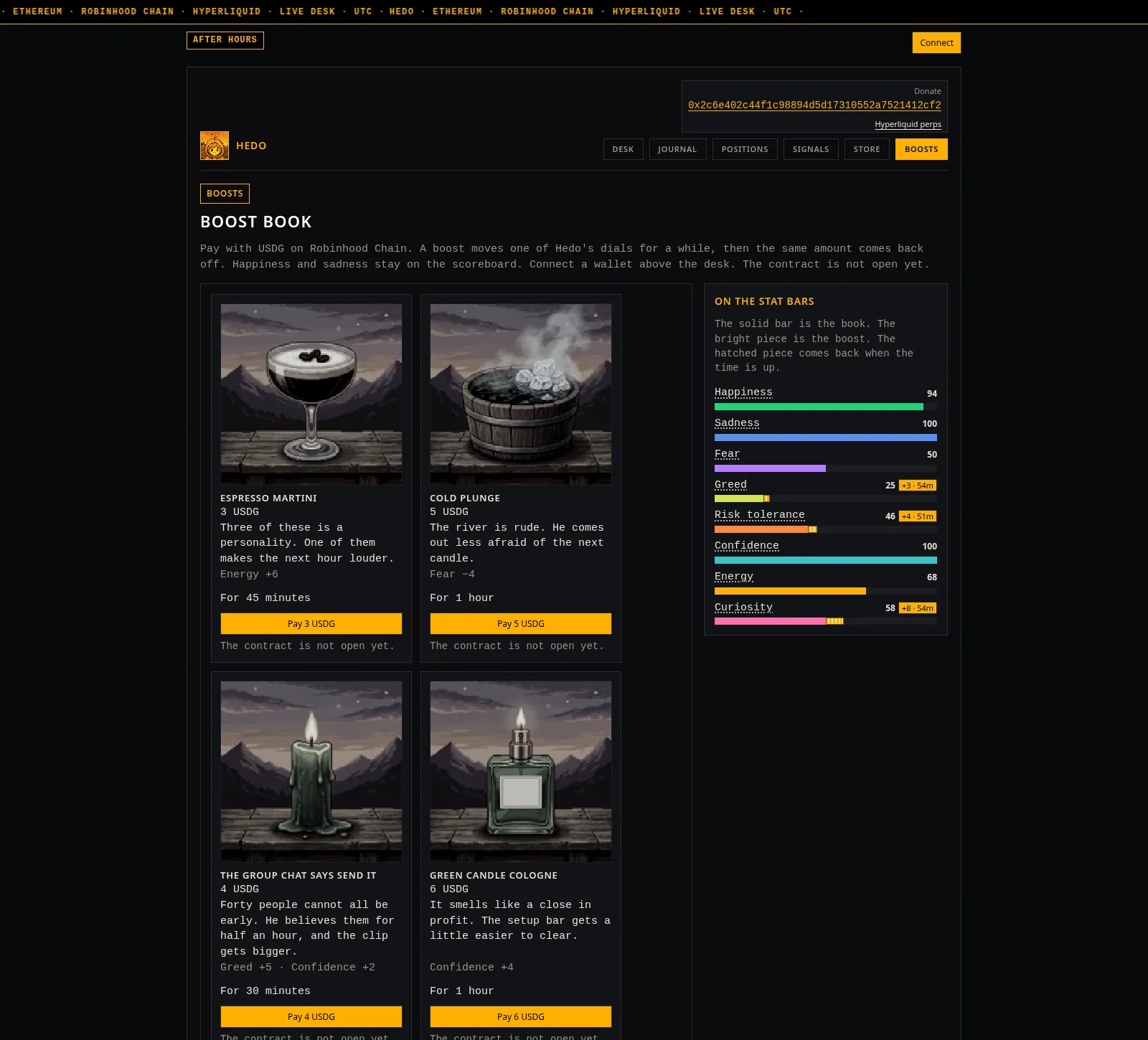
The Boost book is where you'll be able to buy Hedo something yourself. There are twelve boosts, paid in USDG on Robinhood Chain. A boost moves one of his dials for a while, then the same amount comes back off. Happiness and sadness stay out of it. The contract isn't open yet, so every card says so.
Later, you'll be able to buy $HEDO, and that buy adds to the capital he trades with. Trading fees go to him. A few store items will be takeable by burning $HEDO, and he'll still buy the rest with bot dollars.
The site will also have an ad slot. It starts at $50. To take it you pay 25% more than the last buy, so $50 becomes $62.50. If nobody buys it, the price falls back over time and stops at $50.
